

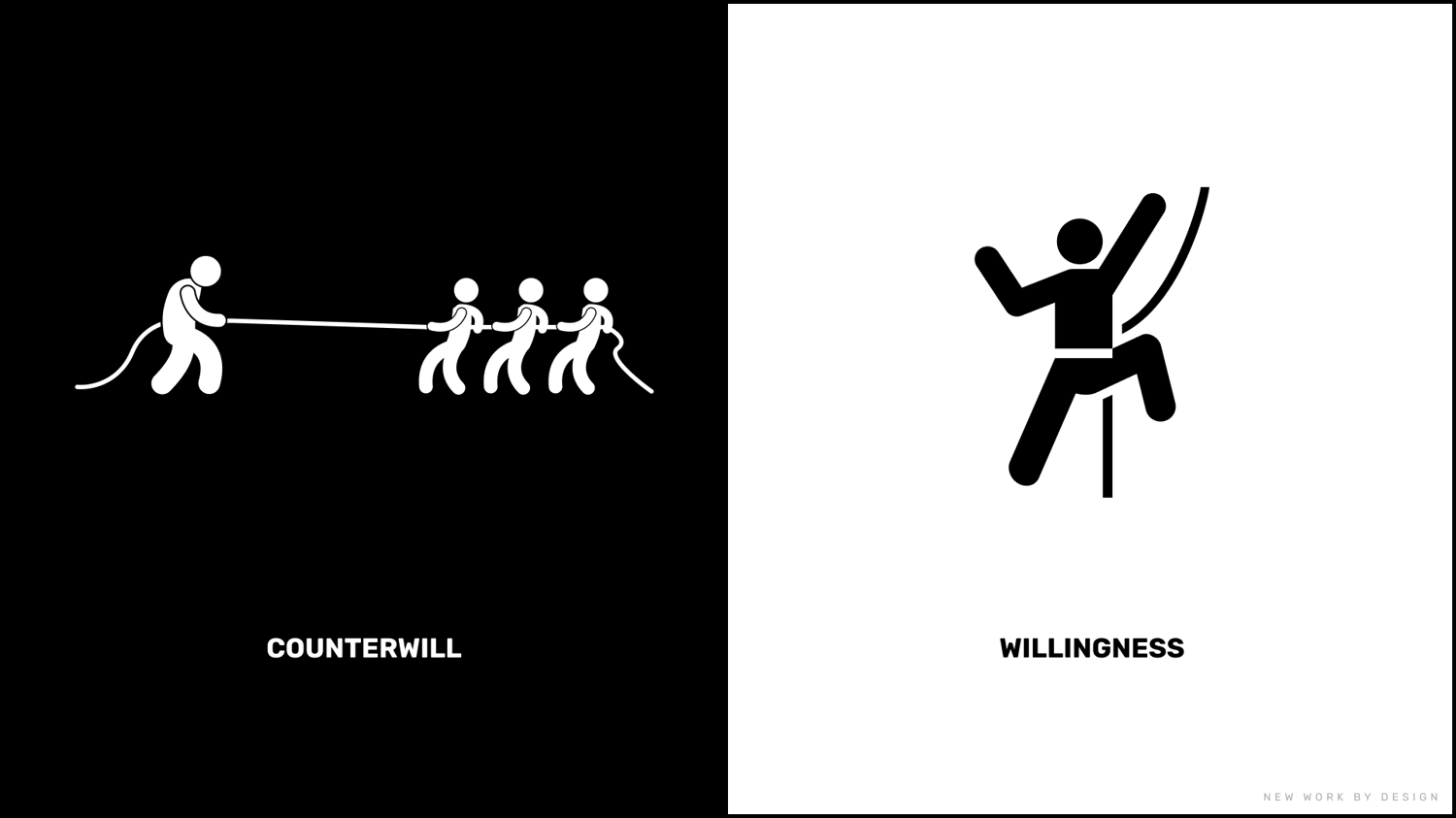
Have you ever wondered why some people resist even the best-intentioned initiatives? Why does a new policy, designed to improve motivation, instead spark resistance?
The answer lies in an instinctive force called counterwill—a natural opposition to being controlled and deeply tied to human autonomy.
The concept of counterwill was introduced by Austrian psychologist Otto Rank (1920s) and later expanded on by developmental psychologist Dr. Gordon Neufeld (1990s and 2000s).
Counterwill is an instinctive, automatic resistance to any sense of being forced. It is not defiance for the sake of defiance but rather a protective mechanism designed to safeguard autonomy. It appears most strongly in children and adolescents, but it doesn’t disappear in adulthood—it simply takes more subtle forms in the workplace.
In a professional setting, counterwill might look like:
- Passive resistance to new policies.
- Procrastination or selective compliance.
- Cynicism toward leadership decisions.
- Disengagement when micromanaged.
Counterwill and motivation
Counterwill is low in environments that foster intrinsic motivation because people feel a sense of agency. Extrinsic motivators, on the other hand, trigger counterwill. People may perceive directives as imposed, leading to disengagement and resistance.
Counterwill also explains why rewards kill previously present intrinsic motivation. Rewards are "positive" coercion. They too trigger counterwill. They work to change behavior as long as the rewards keep coming. "Stop the pay, stop the play."
Counterwill is not a flaw in human behavior—it’s a sign that an individual values autonomy. Leaders who recognize this can design workplaces where employees feel inspired rather than coerced. By tapping into intrinsic motivation and allowing for autonomy, organizations can transform resistance into engagement.
How to minimize counterwill
The key to reducing counterwill is to create an environment where people feel autonomous rather than controlled. This requires a shift from using authority power to integrative power fostering psychological ownership. Here’s how:
- Involve people in decision-making: When people have a say in policies, resistance decreases. Involvement creates commitment. Seek input before implementing changes.
- Give people more autonomy: Develop people from needing detailed instruction on task level to goal-oriented guidance. Allow them to determine how they achieve the desired outcome.
- Explain the "Why": Instead of framing tasks as obligations, tie them to a meaningful purpose that aligns with the people’s values.
- Avoid over-reliance on external rewards: If employees only work for a bonus, they will disengage once the reward loses its appeal. Intrinsic motivation must be nurtured alongside extrinsic rewards.
🧪 Try this experiment: This week, pick a workplace policy that has met resistance.
- Ask 5 colleagues:
- How does this policy impact your sense of autonomy?
- What changes would make this policy feel more empowering?
- Are there alternative ways to achieve the same goal that align better with intrinsic motivation?
- Compare the responses and experiment with small adjustments to observe the impact on engagement.
🤓 Fun Fact: Research suggests that when we feel controlled, our brain's natural response is to resist, even if the directive aligns with our own interests. Figuring out what we want has to begin with having the freedom to not want. We resist the “shoulds” of others in order to discover our own preferences. Our brain blocks out any ideas or thoughts that have not originated within ourselves in order to make room for us to come up with our own wants. It’s a psychological immune system, reacting defensively to anything that does not originate within ourselves.
🤔 What if...? What if organizations eliminated all top-down directives and let employees self-organize entirely? Would workplaces become more innovative and engaged, or would chaos ensue? What kind of leadership would naturally emerge?
If you want to receive visualized concepts like this with simple experiments in your inbox when they come out on Monday mornings, sign up at visuals.newworkbydesign.com
Comments ()