

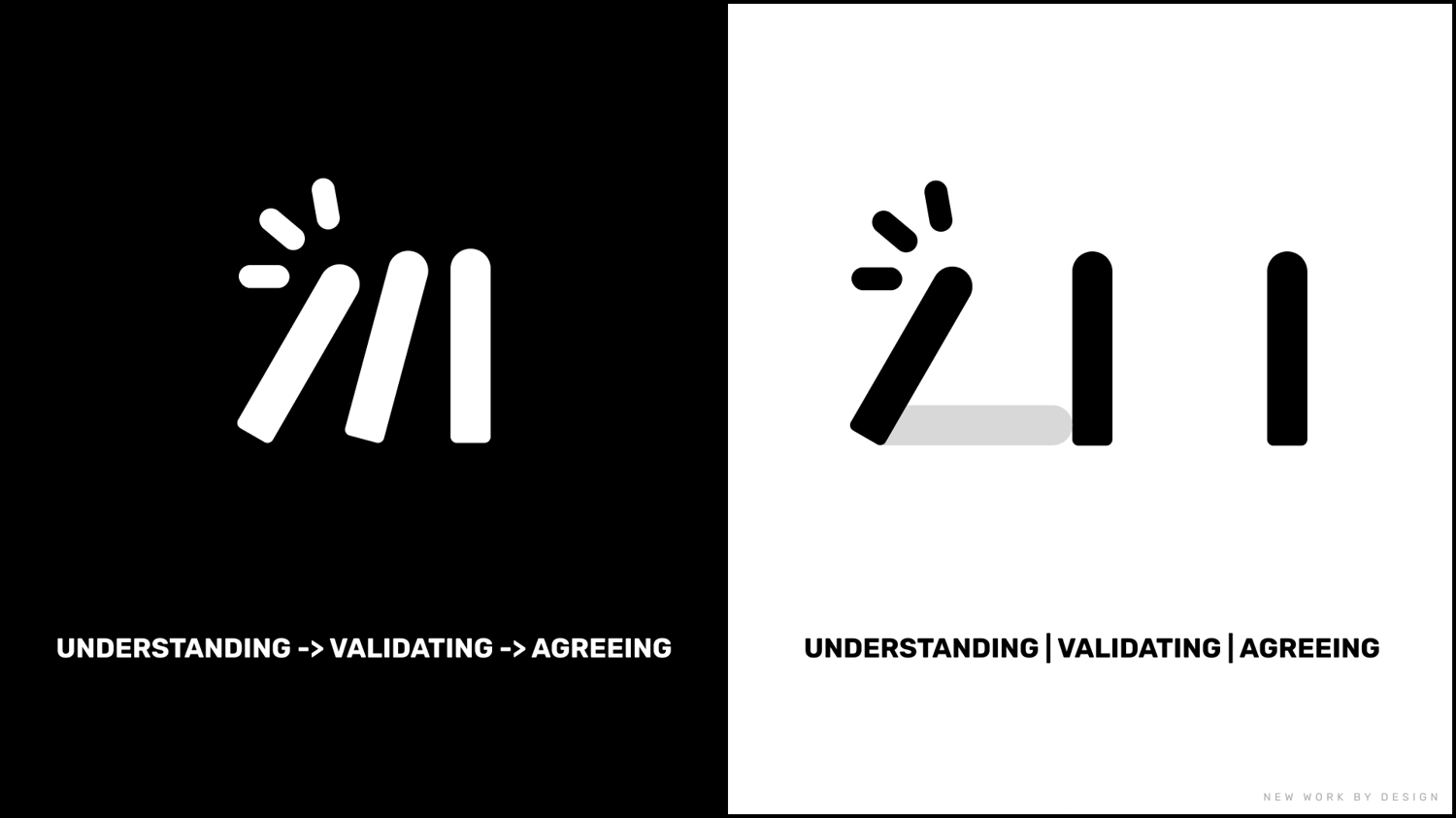
Have you ever been in an argument where someone outright refuses to even consider your point of view? Maybe they dismiss it immediately, calling it "ridiculous" or "unrealistic." Or perhaps you've caught yourself doing the same.
This harding of sides often comes from a simple but powerful misconception: we conflate understanding, validating, and agreeing as if one would automatically lead to the next. But they don't.
1. Understanding
"I know what you mean and can explain why you think that way."
Example: If someone argues, "If we allow remote work, people will just slack off at home and not get any work done," another person may dismiss it outright. But what if the concerned person had past experiences with unreliable employees? Understanding doesn’t mean agreeing—it just means recognizing why they think the way they do.
2. Validating
"I acknowledge your reaction as human and can see how, from your perspective, it makes sense—even if I don't share it."
Example: Someone worried about remote work might fear a loss of accountability. A poor response would be, "That's ridiculous. You’re just paranoid." A validating response would be, "I see why that concerns you. Some teams do struggle with accountability when remote." This doesn’t mean agreement—it just acknowledges their reasoning.
3. Agreement
"I agree with your position and think it’s a good idea."
Example: Even if you don't agree, you can say, "I see why you’re worried that remote work could reduce accountability. I think we can mitigate that risk rather than rejecting flexibility altogether. What would a safe experiment look like to test if your fear becomes true?" This keeps the conversation open and invites experimentation rather than shutting it down.
Why This Matters
People avoid taking others' perspectives in arguments because they conflate understanding, validating, and agreeing—fearing that if they understand another's reasoning, they must accept it as correct.
Interestingly, in German, the words for all three levels have the same root:
- Verstehen (understand)
- Verständnis haben (validate)
- Einverstanden sein (agree)
This linguistic connection highlights how closely we perceive them. But when we intentionally separate these levels, we can break free from this mental trap and create space for more productive discussions. If we want to have any chance at resolving conflicts and finding a shared way forward, we have to go through steps one and two. Step three is not required.
🧪 Try this experiment: This week
- Identify a stuck topic at work where you feel resistance to understanding because you fear being perceived as agreeing.
- Approach a person with an opposing view on the topic and say: “I don’t agree with your perspective on X, but I would like to at least understand it better. Can you explain to me...?”
- Focus on understanding first and validating their concerns. Avoid arguing your perspective.
🤓 Fun Fact: Research shows that when people feel understood, their brains release oxytocin—the same chemical associated with trust and bonding. Simply making someone feel heard can lower stress and create a more collaborative conversation. (The Moral Molecule: How Trust Works by Paul J. Zak)
🤔 What if...? Imagine a world where every disagreement was met with curiosity rather than defensiveness. Workplaces would be more innovative, relationships more resilient, and conflicts more constructive. What if we made this shift, one conversation at a time?
If you want to receive visualized concepts like this with simple experiments in your inbox when they come out on Monday mornings, sign up at visuals.newworkbydesign.com
Comments ()