

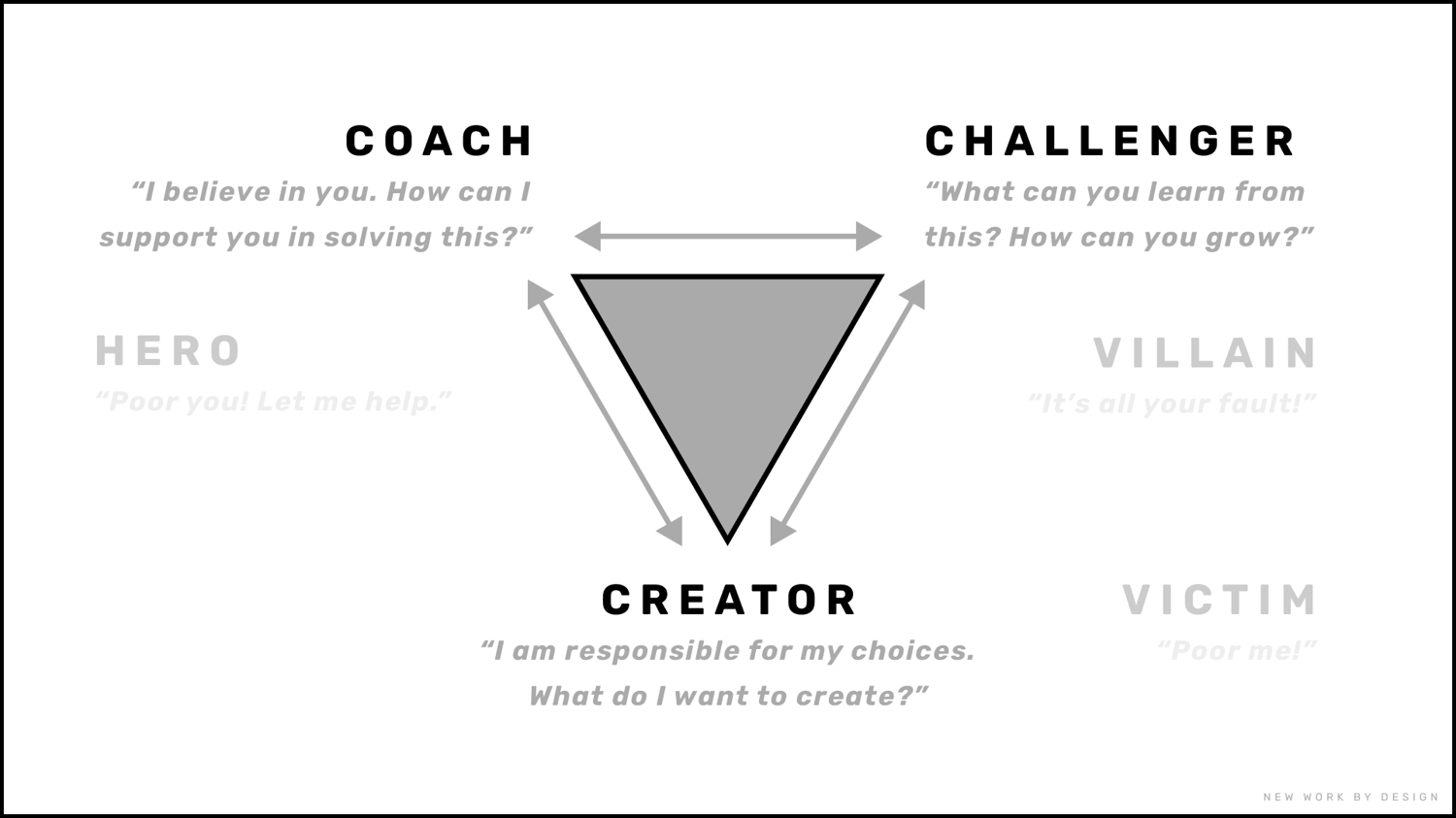
The Empowerment Dynamic (TED) is a constructive alternative to the well-known Drama Triangle.
While the Drama Triangle, developed by Dr. Stephen Karpman, revolves around conflict-driven roles—Victim, Villain, and Hero—TED encourages a shift toward solution-oriented thinking and collaboration. Here’s how the roles transform:
- Creator (replacing the Victim): The Creator focuses on solutions, looks for opportunities to grow, and takes ownership for their choices and actions.
- Challenger (replacing the Villain): The Challenger offers constructive pushback, encouraging Creators to overcome obstacles through supportive challenge, not blame.
- Coach (replacing the Hero): The Coach asks empowering questions to guide the Creator in finding their own solutions, fostering independence rather than dependency.
Shift from Victim to Creator mindset
The Coach role is particularly useful in helping someone transition from a Victim mindset into that of a Creator. Below are some questions Coaches can use to facilitate this shift:
Phase 1: Shift perspective: Start by addressing the mindset and underlying story. This phase is crucial for loosening the grip of the Victim role.
- What story are you telling yourself about this situation, and is there another way to look at it?
- The Victim role often involves unhelpful narratives. This question challenges limiting stories and invites a reframing toward more empowering ones.
- What’s important to you about resolving this situation?
- Shifts focus from the problem to a desired outcome. This questions uncovers underlying values and motivation.
Phase 2: Reclaim control: Once the perspective has started to shift, the next step is to focus on what they can control.
- What’s within your control right now?
- Addresses the feeling of helplessness in the Victim role but focuses attention on actionable elements, no matter how small.
- If you were advising a friend in your situation, what would you suggest they do?Distancing oneself from the problem often leads to more objective and empowered thinking. This question can help someone see the situation from a new angle.
Phase 3: Explore opportunities: With clarity and control in place, the next step is to broaden their thinking and identify resources.
- What strengths have helped you in similar situations before?
- Reminds the person of their capabilities. Anchoring it in past successes makes the reflection tangible and builds confidence.
- Who can support you, and how can you ask for their help?
- Shifting from helplessness to action often requires reaching out. This question not only identifies potential allies but also encourages vulnerability and proactive communication.
Phase 4: Define the path forward: Now it’s time to create a concrete path forward with small, manageable steps.
- What’s a possible future you’d like to create out of this?
- Encourages imagining a better scenario rather than remaining stuck in the present problem. This taps into creativity and solution-oriented thinking, central to the Creator role.
- What’s one small step you can take right now toward your goal?
- Emphasizes immediate action, breaking down the path into something manageable. It builds momentum and helps avoid procrastination by focusing on the next actionable step.
These questions not only steer conversations toward constructive thinking but also cultivate a mindset of self-empowerment and proactive problem-solving.
A simple experiment
Identify a situation where you feel stuck.
- Answer the questions above about this situation.
- Notice changes in your perspective about the situation.
- Ask your lead or mentor if they are willing to act as Coach and Challenger in your next 1:1 to discuss your responses.
If you want to receive visualized concepts like this with simple experiments in your inbox when they come out on Monday mornings, sign up at visuals.newworkbydesign.com
Comments ()