

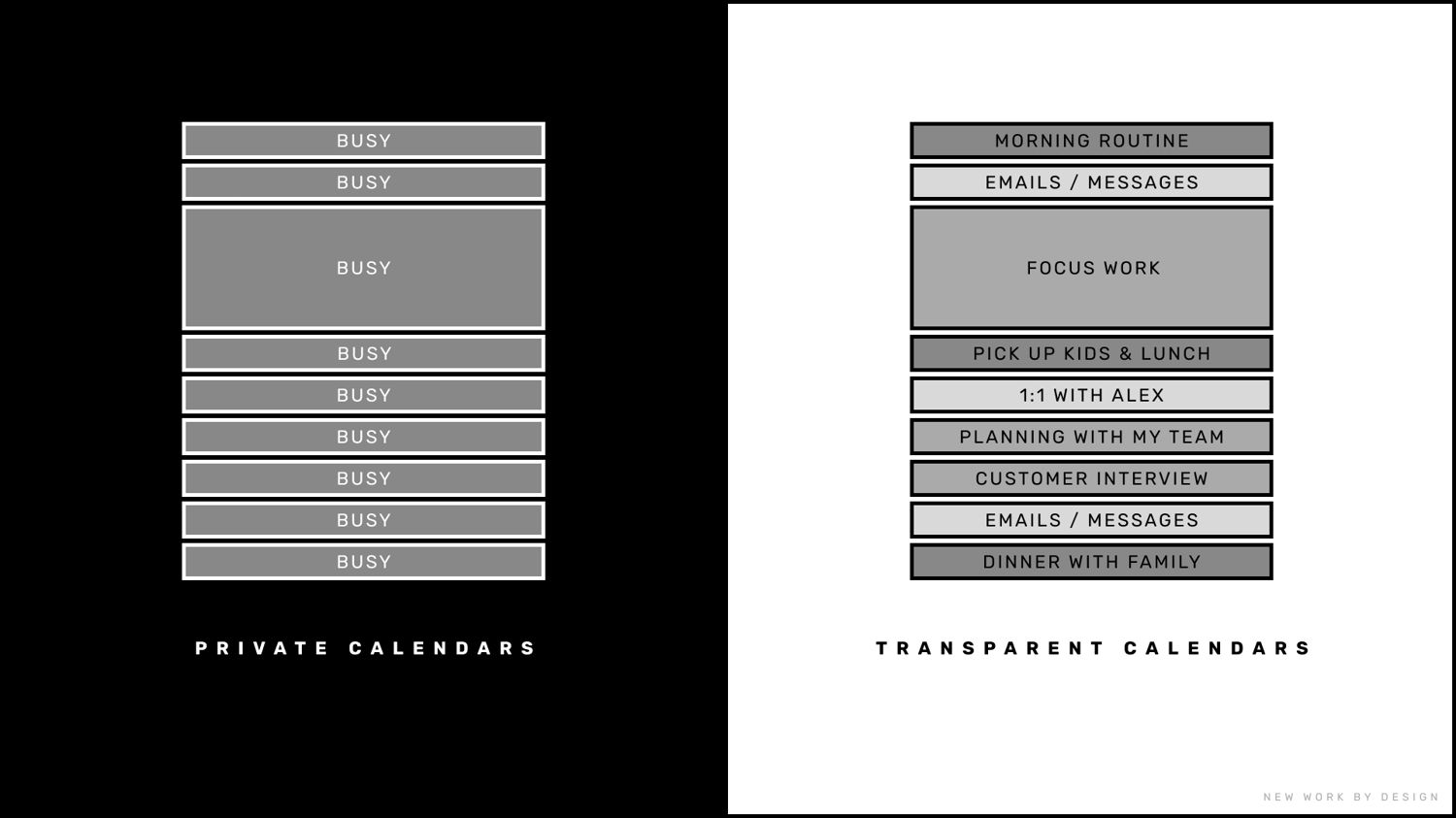
Ever tried scheduling an urgent team meeting, only to find the next open slot is six weeks away? You’re then left with these options:
- Book an unpopular lunchtime meeting.
- Settle for that far-off slot, knowing the topic might be obsolete by then.
- Attempt the tedious task of asking if team members can shuffle their meetings, leading to endless back and forth.
All of these options suck! But there’s one change that makes the last option much easier: transparent calendars.
Scheduling meetings for a group of people can be frustrating because calendars of participants are often already full. In many cases an existing meeting would be easy to move (e.g. if it’s a blocker for a mundane task like answering emails), but this is impossible to judge if the event details are hidden.
This requires unnecessary coordination. Time and effort you could spend on value-adding activities instead. Because it is so tedious, often these extra coordination steps are not taken and you end up with later, less relevant meetings than you could have.
But what about confidential meetings? You can still mark specific events as private when needed. Transparency just becomes the default.
You’ll know this was a success if you see:
- Faster, more efficient scheduling.
- Fewer messages about clearing up a desired meeting slot.
A simple experiment
- Lead by Example: Make your own calendar transparent.
- Local change: Ask your team to do the same (at least within your team)
- Change the default: Ask your systems admin to change the default settings for calendar events for every employee. Existing and new ones. This only takes a few minutes. Each individual can change their default back in their settings or per event if they so choose. This too, only takes a few minutes.
Here is an example advice process proposal to make it happen.
While you are at it, make calendar events editable by participants, would you? It’s frustrating to have a meeting set up that only the organizer can edit. Allowing participants to add helpful info—like a pre-read—saves everyone from unnecessary coordination and admin tasks.
If you want to receive visualized concepts like this with simple experiments in your inbox when they come out on Monday mornings, sign up at visuals.newworkbydesign.com
Comments ()