

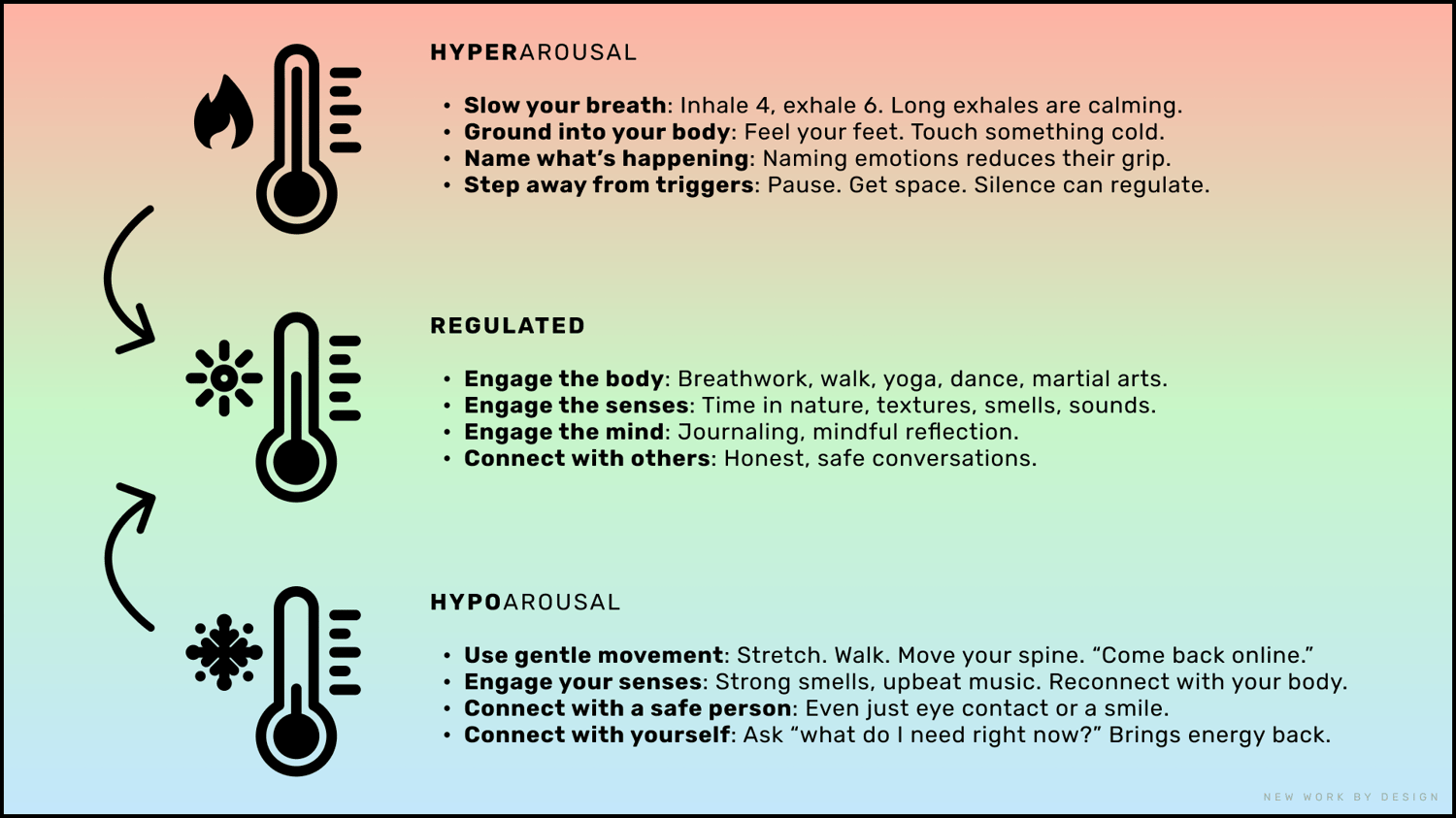
Interactions at work throw us off balance sometimes. The ability to bring ourselves back to a regulated state can significantly impact our decision-making, interpersonal interactions, and overall productivity. Let’s explore how to recognize and navigate these states effectively.
There are three main nervous system states: hyperarousal, regulated, hypoarousal. While we aim for staying in a regulated state as much as possible, it is inevitable that we will find ourselves in hyperarousal or hypoarousal at times.
The key is to recognize these states and use targeted techniques to bring our nervous system back to balance.

Why this matters at work
At work, a dysregulated nervous system impairs our decision-making, hinders effective communication, and escalates conflicts. By learning to self-regulate, we can foster clearer thinking, stronger connections, and more constructive responses under pressure. Understanding how to self-regulate is like having a personal toolkit for navigating difficult moments with more grace and resilience.
Techniques for hyperarousal
Example: Imagine you're in a tense meeting where your work is being heavily criticized. Your heart races, your breathing quickens, and you feel the urge to react defensively. This is hyperarousal.
Here’s how to bring yourself back to a regulated state:
- Slow your breath: Inhale for 4 seconds, exhale for 6. Longer exhales activate the parasympathetic system, calming the body.
- Ground into your body: Press your feet firmly against the ground. Hold a cool object or splash cold water on your face.
- Name what’s happening: Verbally identify your emotions. Research shows that labeling feelings reduces their intensity.
- Step away from triggers: Remove yourself from overstimulating environments. Even a minute of silence can reset the system.
Techniques for hypoarousal
Example: Imagine you’re staring blankly at your screen, unable to focus, feeling mentally checked out during a long virtual meeting. This is hypoarousal.
To re-energize and reconnect, try these:
- Use gentle movement: Stretch, walk, or sway your spine. Movement reactivates the body and increases alertness.
- Engage your senses: Smell a strong scent, listen to upbeat music, or touch something textured. Sensory input helps you reconnect.
- Connect with a safe person: Eye contact, a smile, or a brief conversation can pull you out of shutdown.
- Connect with yourself: Ask “what do I need right now?” Self-inquiry brings your awareness back to the present and sparks a small action to reconnect.
🧪 A simple experiment
This week,
- Pick one technique for hyperarousal and one for hypoarousal that resonates with you.
- When you notice yourself in either state, practice the respective technique.
- At the end of the week, reflect: Did you feel more in control of your responses? Was it easier to return to a regulated state?
🤓 Fun fact
Did you know that the human vagus nerve, the longest cranial nerve, plays a crucial role in regulating our nervous system? It connects the brain to vital organs like the heart, lungs, and gut. Activating the vagus nerve through deep breathing, humming, or a cold splash of water can effectively calm hyperarousal, bringing us back to a regulated state.
🤔 What if…?
What if workplaces had "Nervous System Regulation Rooms" where employees could step in for five-minute reset sessions? These rooms would include a variety of tools: calming music, weighted blankets, breathing exercises, and sensory stimuli designed to regulate the nervous system. Imagine a workplace where maintaining nervous system balance was as normal as grabbing a coffee.
If you want to receive visualized concepts like this with simple experiments in your inbox when they come out on Monday mornings, sign up at visuals.newworkbydesign.com
Comments ()