

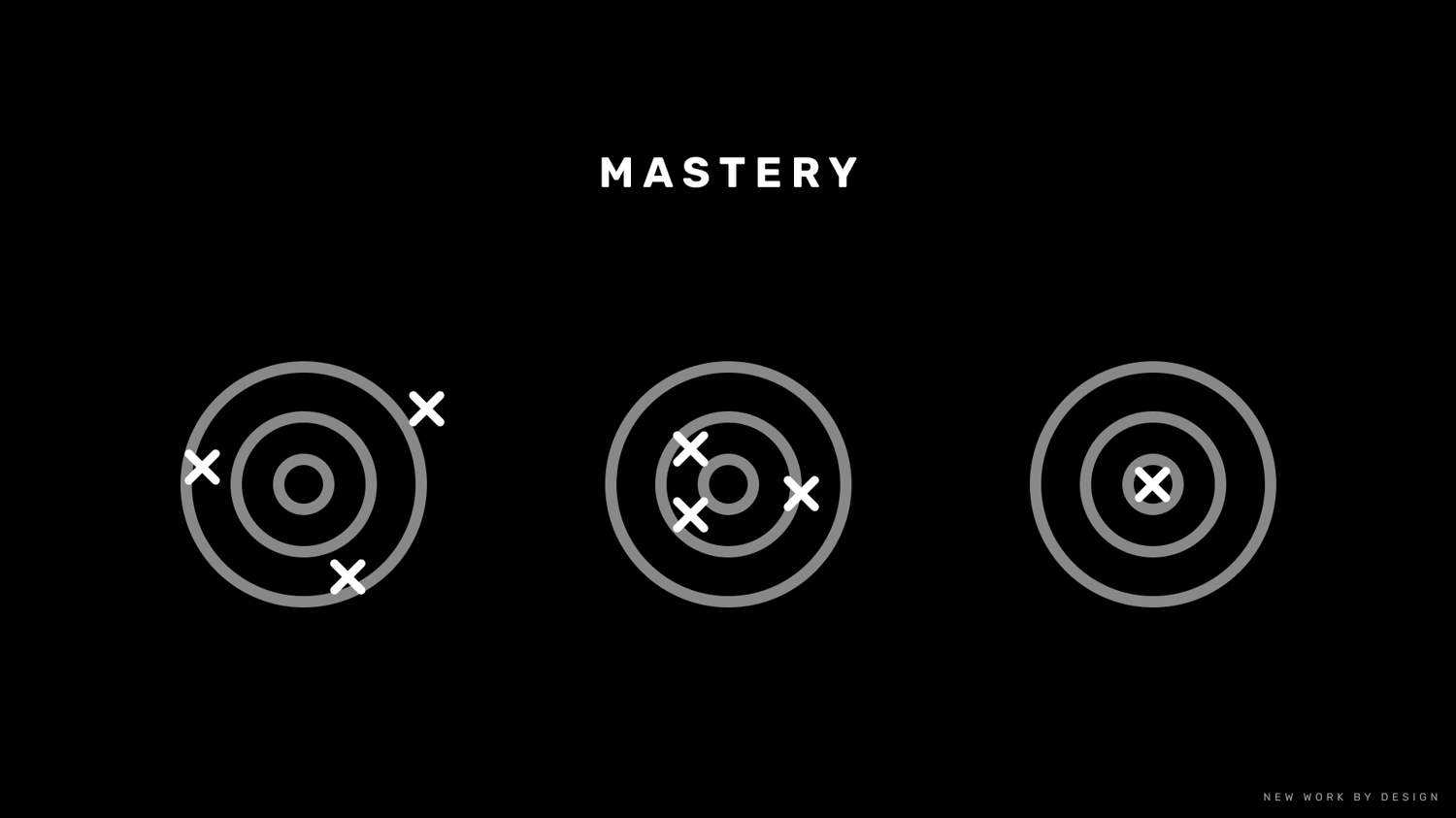
Mastery is a cornerstone of intrinsic motivation. I like to think of it as: “Knowing I’m skilled at what I do and continuously putting in the work to get better through deliberate practice.”
Mastery is about striving for perfection in your craft, even knowing that perfection is never fully attainable.
There are various learning models that can help guide the pursuit of growth, but two in particular stand out to me:
- Deliberate Practice: for improving doing something, and
- The Feynman Technique: for improving understanding
Deliberate Practice
This model focuses on targeted, structured efforts to enhance specific skills. Here's how:
- Specific goals: Working on specific areas of weakness or skills.
- Immediate feedback: Getting clear, actionable feedback to improve.
- Consistent effort: Regular, sustained practice over long periods.
- Stretching ability: Pushing slightly beyond current skill level.
The 10,000-hour rule, popularized by Malcolm Gladwell in his book Outliers, suggests that it takes around 10,000 hours of focused, deliberate practice to achieve mastery in any field. While the number is debatable, I find it useful as an illustration that there is no over-night success in attaining mastery.
The Feynman Technique
Named after physicist Richard Feynman, this model emphasizes deep understanding through teaching. The steps are:
- Learn the concept: Understand the material or skill.
- Explain it in simple terms: Try to teach it as if you’re explaining it to a beginner.
- Identify gaps: When you struggle to explain something, it highlights areas where your understanding is weak.
- Review and refine: Go back to the source material or practice and fill in the gaps, then explain it again.
This method ensures you’re not just memorizing but truly understanding the craft on a deep level.
A simple experiment
What's your craft? What is the thing that you want to become one of the best at? Once you know:
- Deliberate Practice: Schedule regular sessions to work on your skills in your calendar. Simply doing your job isn’t the same as focused practice.
- The Feynman Technique: Submit a proposal to share what you know with others—whether it’s through company-internal knowledge-sharing sessions, mentoring a less experienced colleague, or public speaking at meetups or conferences. Teaching is a powerful way to solidify your understanding.
If you want to receive visualized concepts like this with simple experiments in your inbox when they come out on Monday mornings, sign up at visuals.newworkbydesign.com
Comments ()