

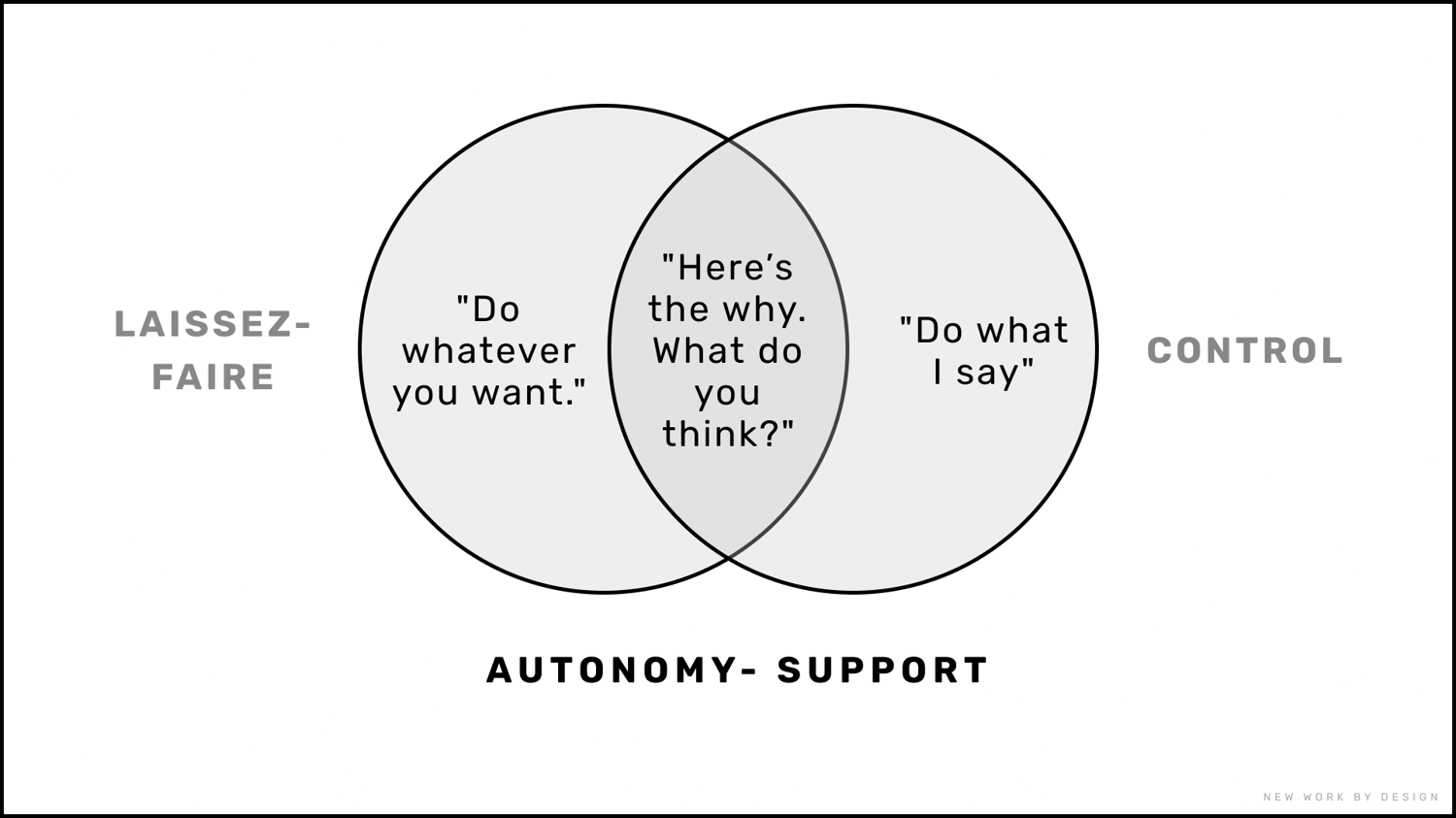
We talk a lot about autonomy at work. But too often, we get it wrong. Supporting autonomy doesn't mean saying yes to everything. It doesn't mean stepping back and hoping for the best. It means creating conditions where people feel trusted, heard, and connected to purpose—while still being guided.
Autonomy support isn’t about saying yes to everything.
It’s about perspective-taking. It’s about creating space for choice, but within a framework that connects to purpose. When people feel understood (instead of coerced), they engage. They own it. They grow.
And here’s the trap: when we’re under pressure, we often swing into control mode. Deadlines loom, results dip, and we start micromanaging. It’s understandable but it erodes trust and motivation.
The science backs this up:
- Autonomy-support ≠ absence: People feel more autonomous when supported than when left alone.
- Control backfires: It triggers resistance or disengagement.
Example
Imagine you’re leading a project that’s falling behind. You feel pressure, maybe from leadership, maybe from your own high standards. In response, you start tightening the screws: daily task updates, frequent nudges, hovering over Slack.
What do you think will be the impact on motivation?
Then you pause and ask yourself: “What if my job isn’t to push harder, but to reconnect people to the why?”
So you shift. Instead of reminders, you start conversations: “What’s your take on this deadline? What’s blocking you?”
My prediction: Within days, the mood changes. People take ownership. They step up. Not because you forced them, but because you made space for them.
🧪 Experiment: This week, pick one conversation where you feel tempted to control.
Instead, try:
- Name the goal clearly
- Ask for their view
- Give meaningful rationale, not just instructions
See how they respond. See how you feel, too.
🤓 Fun Fact: Octopuses have nine brains, but they don't centralize control. Each arm can make decisions independently, yet they still coordinate beautifully. It’s a reminder that decentralization—when designed well—can lead to intelligent, adaptive behavior. Sounds a lot like autonomy support, doesn’t it?
🤔 What if...?: What if your chat tool nudged you each time you were about to send a controlling message? Imagine a “tone check” pop-up: “Want to rephrase that as a choice with context?” Autonomy support, built right into your workflow.
Want to receive visualized concepts like this with simple experiments in your inbox when they come out on Monday mornings? Sign up at visuals.newworkbydesign.com
Comments ()