

Talking about paying people fairly requires agreeing on what fairness means (a subjective notion) and acknowledging the historical disadvantages faced by certain groups, particularly women (aka the gender pay gap).
Fairpay is used as a platform to address these important issues. These topics are highly polarized and I won’t address them directly in this newsletter issue. Instead, I will try to give a sober definition of what Fairpay is from my perspective and let you draw your own conclusions, if my proposal is fair and avoids pay gaps.
Fairpay
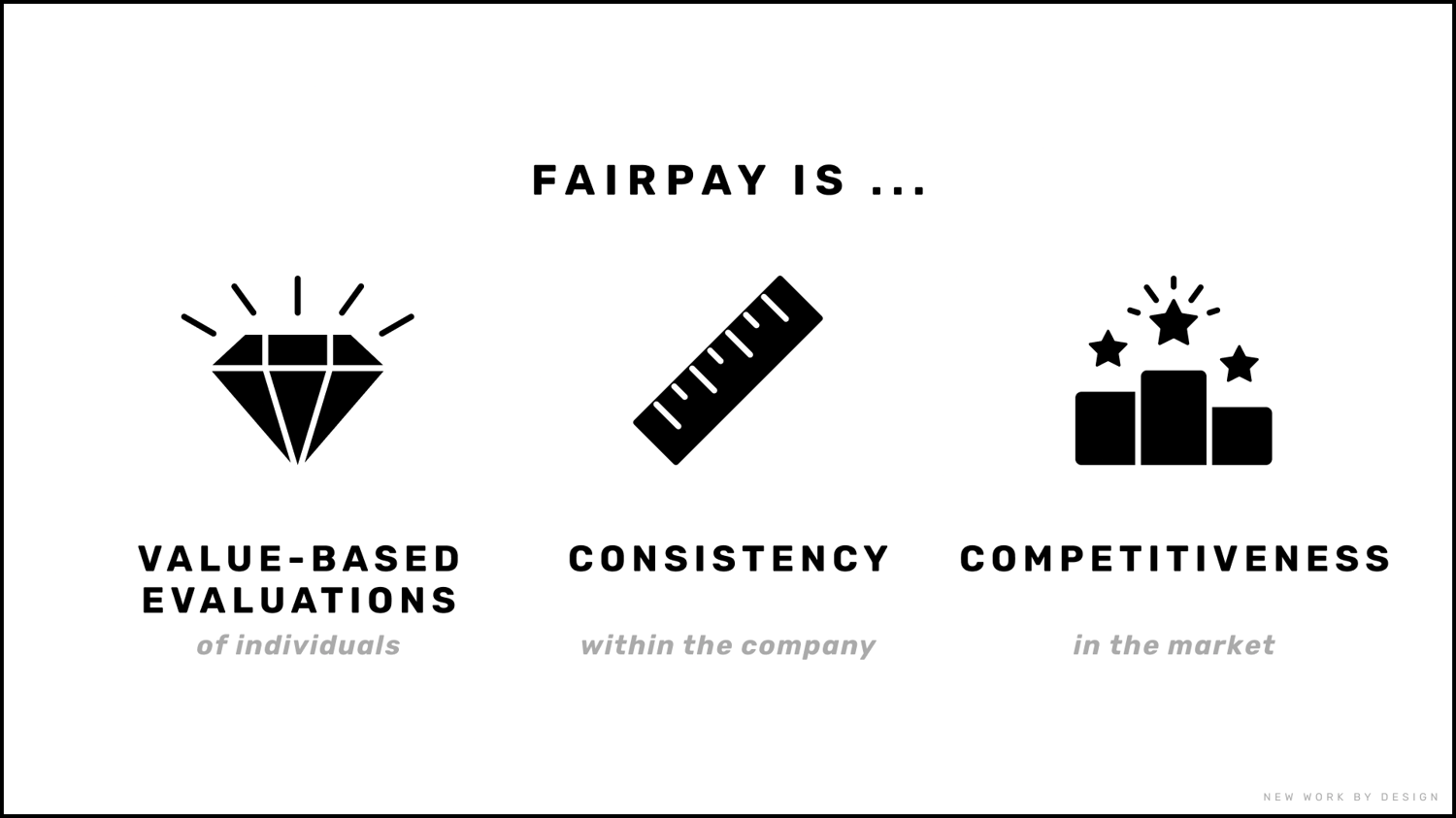
Fairpay is
- a person’s value to the company
- consistently evaluated across the organization
- benchmarked against the market.
Let’s explore how to implement these principles in a way that feels fair.
Person
- Peer evaluation: Everyone gets evaluated by 5-8 people who have worked closely with them.
- Competency model: Evaluations are based on a competency model that reflects the company’s values, considering both results and behavior.
- Council: A diverse council interprets the evaluations and ranks employees based on their contributions.
Company
- Procedural justice: Everyone’s salary is determined through the same process.
- No negotiations: There are no secret individual negotiations and adjustments.
- Clarity: Everyone understands how the process works.
Market
- Data collection: Gather relevant market data. This can be tricky and expensive, so keep it simple. Use your own hiring data and compare your salaries with trusted companies you have connections with.
- Competitiveness: Decide how competitive you want your salaries to be. Aim for average, instead, differentiate with an outstanding culture.
- Staying true to yourself: If the market rate for a role seems unfair to you, pay what you believe is fair based on your values.
There is much more to say about Fairpay and how to run a performance evaluation process to achieve it.
Here is a short video with some additional comments.
My suggested implementation for performance evaluation is described in detail in my Transformation course.
A simple experiment
Ask 5 colleagues in a casual setting (perhaps over lunch):
- Do you think you are paid fairly?
- Why does it feel this way to you?
- What do you think you would need to do to earn more?
What are the patterns? Are people clear about how they are evaluated?
If you want to receive visualized concepts like this with simple experiments in your inbox when they come out on Monday mornings, sign up at visuals.newworkbydesign.com
Comments ()