

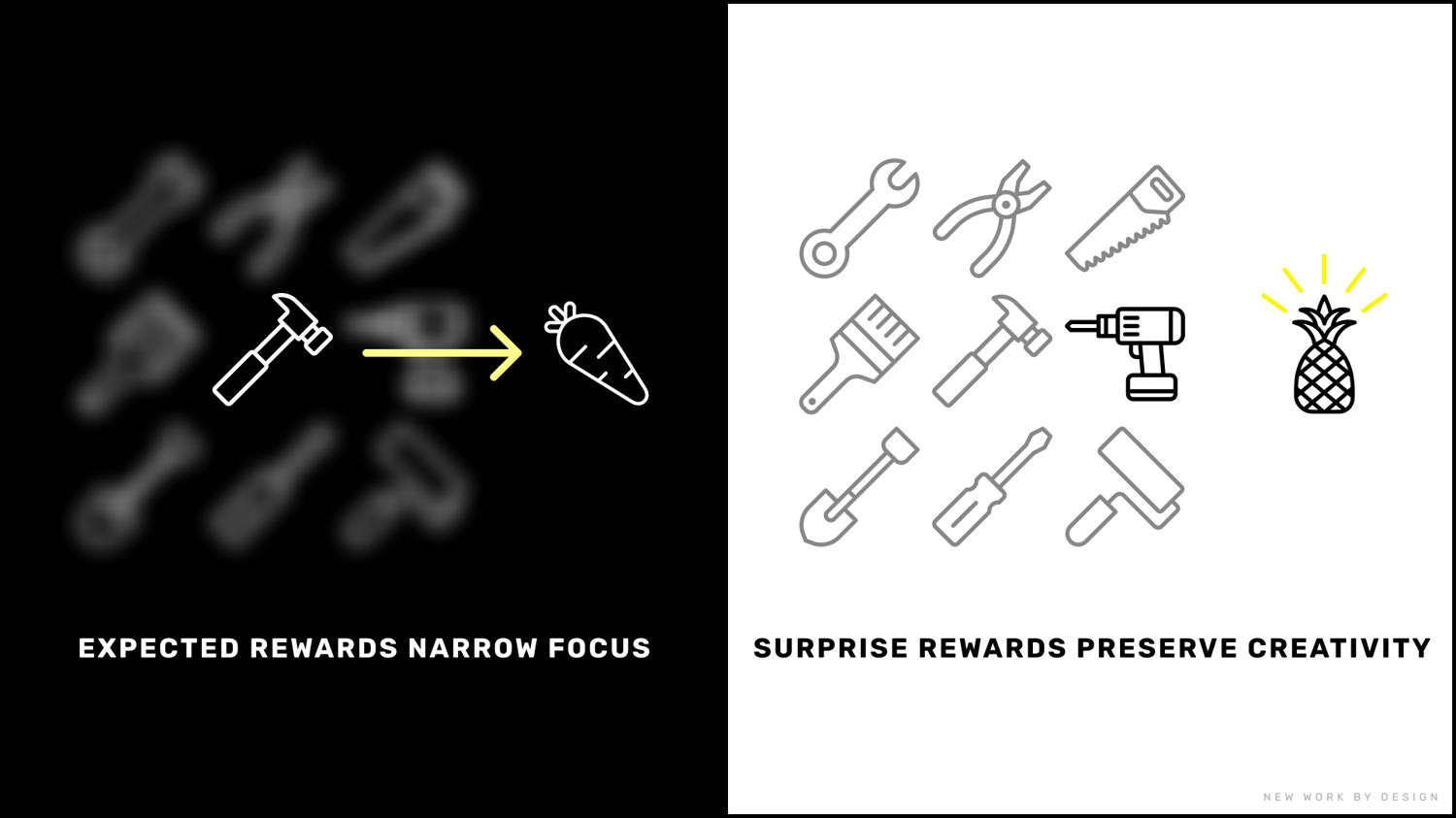
Today, we’re taking a closer look at something that affects motivation more than most people realize: Expected vs. Surprise Rewards.
🥕 Expected rewards (think: “If you hit your target, you get a bonus”) are everywhere in the workplace. They're predictable, and that’s exactly the problem.
🍍 Surprise rewards (as in: “Hey, great job on that project — here’s something to say thanks”) are rare — but surprisingly powerful.
Expected Rewards
“If you do X, then you get Y.”
Expected rewards are tied to performance goals or metrics. And while they can be effective for routine (aka algorithmic) tasks, they often backfire for creative or complex work.
“Extrinsic rewards have clearly detrimental effects on performance of any tasks that require creativity, conceptual understanding, or flexible problem solving.” - Edward Deci
🧠 Why? Because they narrow focus. That’s great when someone’s assembling widgets. But if the job requires innovative thinking, that same focus turns into unwanted tunnel vision.
Example: A product team is promised a big bonus if they launch by Q2. The result? Corners are cut, ideas are rushed, and long-term value is sacrificed for short-term delivery.
💔 Studies show that introducing expected rewards reduces intrinsic motivation. Once the rewards stop, so does the desired behavior. Psychologists call this the "overjustification effect" or more colloquially “stop the pay, stop the play”.
Surprise Rewards
“Now that you’ve done something great — thank you!”
Surprise rewards are not promised in advance. They’re spontaneous gestures of appreciation — a thank-you note, a spontaneous gift, a shoutout in front of the team.
Because they’re unexpected, they hit differently.
🧠 They light up our brains, quite literally. Dopamine — the feel-good chemical — spikes more from unexpected rewards than from ones we saw coming.
Example: After a difficult delivery, the team lead personally thanks each team member with a handwritten note and small treat. No one expected it. Everyone feels seen.
💓 These rewards boost intrinsic motivation, deepen emotional connection, and reinforce a sense of purpose and belonging.
🧪 A simple experiment
Try this with your team this week:
- Don’t announce it.
- Choose one moment where someone went above and beyond.
- Thank them with something small but personal — a message, a coffee, or a little public recognition.
Then watch what happens.
🤓 Fun fact
Our brains evolved to love surprises because they helped our ancestors survive. Finding unexpected fruit in the wild? Dopamine rush. A surprise reward at work today? Same brain, same rush.
🤔 What If…?
Every Friday, your company delivered a mystery reward to one employee who made someone else smile that week — no performance targets, no forms to fill. Just joy, for joy’s sake.
If you want to receive visualized concepts like this with simple experiments in your inbox when they come out on Monday mornings, sign up at visuals.newworkbydesign.com
Comments ()