
How many people can you truly maintain meaningful connections with?
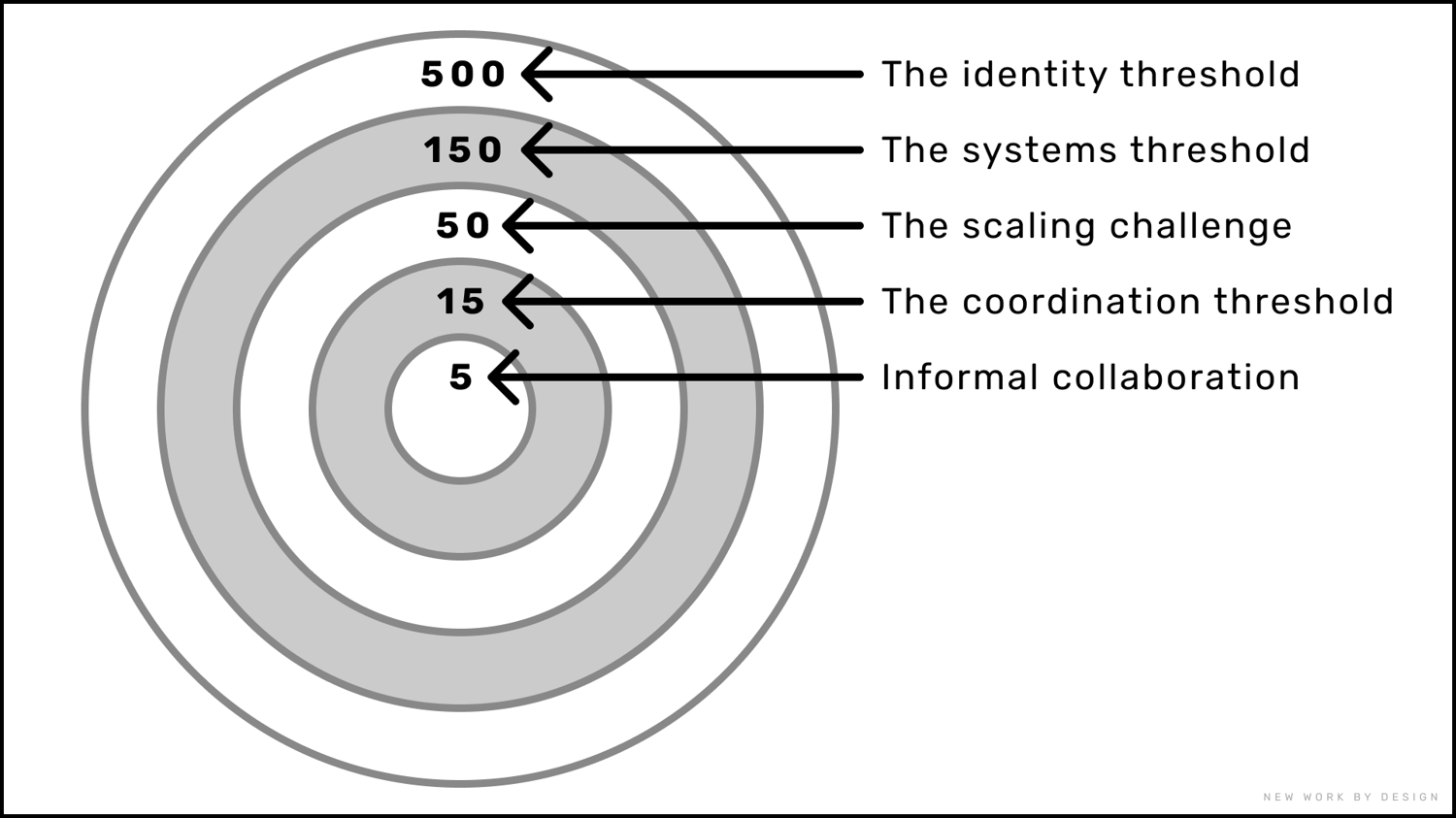
Anthropologist Robin Dunbar has an answer: about 150. But it's actually not just one number. His research suggests that human social circles are layered, each with its own cognitive and emotional limits.
These layers don’t just apply to friendships—they have major implications for how we design and scale companies.
So, let’s take a look at how Dunbar numbers impact communication, trust, and structure in growing organizations.
5 people: Informal collaboration
- Tight relationships form naturally, fostering trust and seamless collaboration.
- Communication flows effortlessly, with little need for formal structure. Decision-making is direct, fast, and based on mutual trust.
15 people: The coordination threshold
- As teams grow, informal communication stops scaling. Sub-groups start to emerge, and alignment requires lightweight coordination tools (e.g., check-ins).
- Beyond 15, informal communication breaks down. This is when teams with high collaboration needs should (at the latest) consider splitting into smaller teams, each with its own mission and coordination process.
50 people: The scaling challenge
- Founders and early leaders can no longer influence culture through direct interaction—values and principles must be explicitly documented.
- Teams require clear roles, shared accountability structures, and access to company-wide information to avoid silos.
- Up to 50 people, founders and early leaders can still directly influence and communicate their vision to everyone.
- Beyond this, implicit culture isn’t enough anymore—it’s time to explicitly articulate company values and operating principles.
150 people: The systems threshold
- Casual interactions no longer sustain alignment. Organizations must intentionally structure communication, decision-making, and leadership (e.g., advice process, decentralized leadership).
- Independent units emerge, requiring cross-unit rituals, and formalized knowledge sharing.
500 people: The identity threshold
- The sense of connection and belonging erodes (especially in hybrid or remote setups). Employees can feel like just another cog in the machine. Without intervention, engagement drops.
- Companies need intentional efforts to foster community—events, rituals, and shared experiences that reconnect people to the organization’s mission and to each other.
🧪 A simple experiment:
- Map out your company’s structure based on Dunbar’s layers.
- Where are communication bottlenecks forming?
- What’s one simple tweak you can make this week to improve flow at your current size?
🤓 Fun Fact: Why 150? Dunbar’s number shows up everywhere. Villages in history, military units, and even Christmas card lists tend to hover around 150 people. It’s the number our brains seem wired to handle for stable social relationships.
🤔 What if companies had ‘social bandwidth meters’ that showed when teams were reaching cognitive overload? Instead of waiting for communication failures, these meters would signal when it’s time to split teams, introduce new processes, or reconnect employees.
If you want to receive visualized concepts like this with simple experiments in your inbox when they come out on Monday mornings, sign up at visuals.newworkbydesign.com
Comments ()