

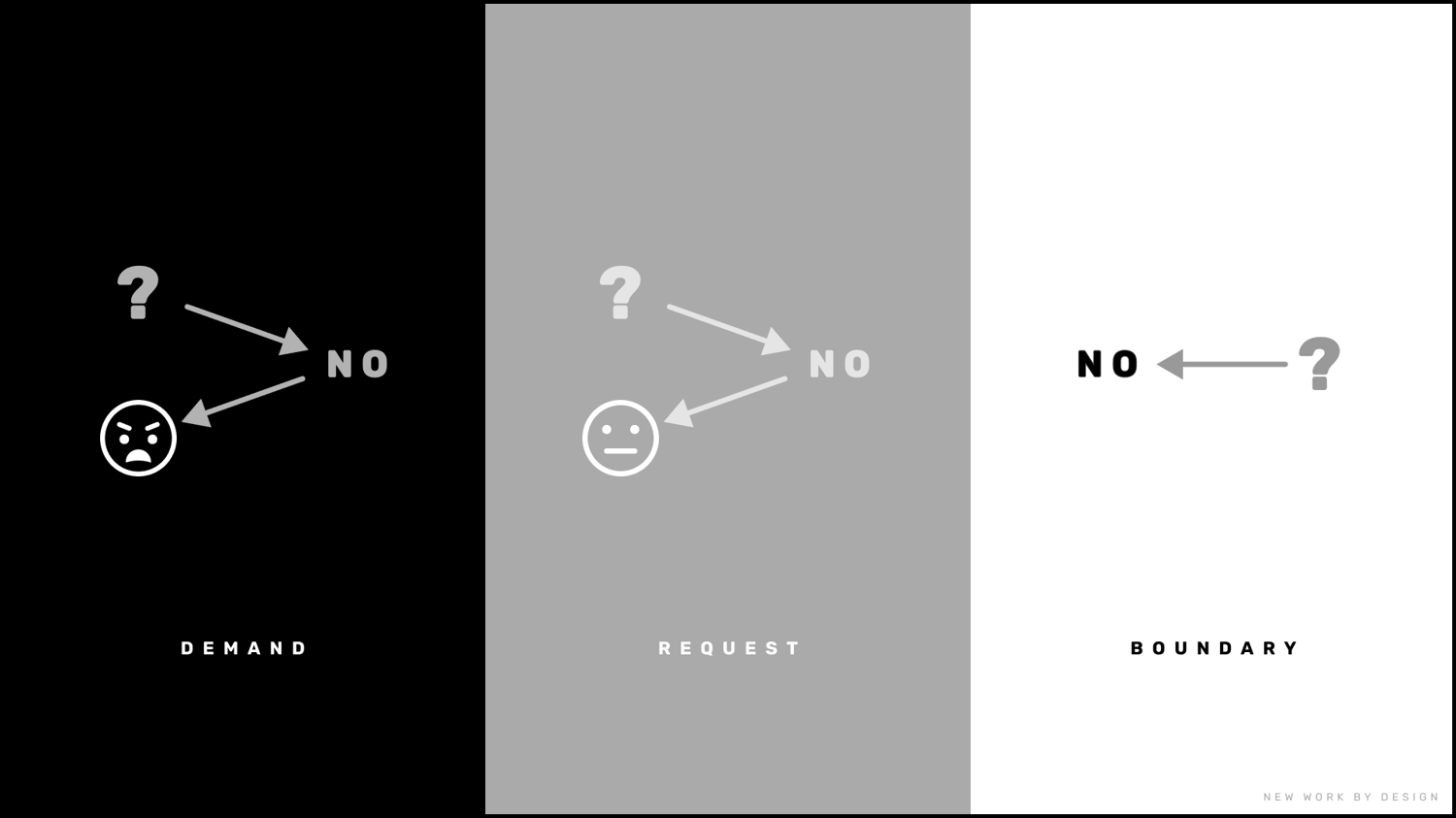
There is a lot of talk about boundaries - yet most people don't have a clear understanding of what a boundary actually is.
To understand what a boundary is, I find it useful to contrast it with what it is not: a demand or a request.
Understanding the difference, though simple, plays a vital role in building productive workplace relationships and will transform how you approach conflicts.
Understanding the difference between these three concepts comes down to what happens when someone says 'No' and who says 'No'.
Demands
Definition: Asking someone to do something, and feeling upset if they say 'No'
Demands come with an emotional price tag. If the answer is 'No,' you feel frustrated or disappointed, often straining the relationship. Demands create an underlying tension, where people feel pressured to comply, leading to burnout or resentment.
Workplace Example: Picture a team lead telling a team member, “I need you to stay late to finish this task.” The team member expresses that they have prior commitments, but the team lead reacts poorly, showing frustration and making critical comments about the team member's commitment. By making this a demand, the team member feels obligated, leading to stress and reduced motivation. Over time, these demands will contribute to lower morale and disengagement.
Requests
Definition: Asking someone to do something, while genuinely being okay if they say 'No'
A request respects the other person’s autonomy. You hope they’ll say 'Yes,' but you’re prepared to accept a 'No' without resentment. This fosters an atmosphere of trust, where people feel empowered to be honest without fear of consequences.
Workplace Example: Suppose you need help on a project and ask your teammate, “Could you assist me with these slides for tomorrow’s meeting?” If they say they’re too busy, you respect their workload and don't hold it against them. In this scenario, the team maintains a respectful, open dynamic where people feel comfortable setting their limits.
Boundaries
Definition: Pre-defining to which requests you will say 'No'
Boundaries are personal limits you set to protect your well-being and values. A boundary isn't about controlling someone else's behavior—it's about your actions, independent of what others do. You take full responsibility for enforcing your boundaries.
While demands and requests are about you asking someone else to do something, boundaries are about someone else asking you to do something.
Workplace Example: Imagine you value your focus time and decide that mornings are for deep work. You ensure with your team that this arrangement works well for everyone and that it doesn't conflict with any recurring team meetings. You take the necessary steps (blocking your calendar, turning off notifications) to maintain that boundary. No one else needs to act for this to be effective—you’ve ensured it by taking action yourself. If someone tries to schedule a morning meeting with you, it is up to you to uphold the boundary you set.
A simple experiment
Think about how you approach communication in your team. Do you set healthy boundaries for yourself, make genuine requests, or unintentionally make demands?
Take 10 minutes to reflect: Think about specific recent interactions this past week where you could categorize your behavior as a demand, request, or boundary. What are your patterns?
Consider these strategies:
- For demands: Be mindful of emotional reactions when people say 'No,' and reflect on how you can turn demands into respectful requests.
- For requests: Ask for help or support without attaching expectations or judgment to the answer.
- For boundaries: Define your limits clearly and make sure you're prepared to uphold them independently.
Healthy boundaries and respectful requests foster a collaborative and fulfilling workplace. Demands, on the other hand, can create tension and resentment.
If you want to receive visualized concepts like this with simple experiments in your inbox when they come out on Monday mornings, sign up at visuals.newworkbydesign.com
Comments ()