

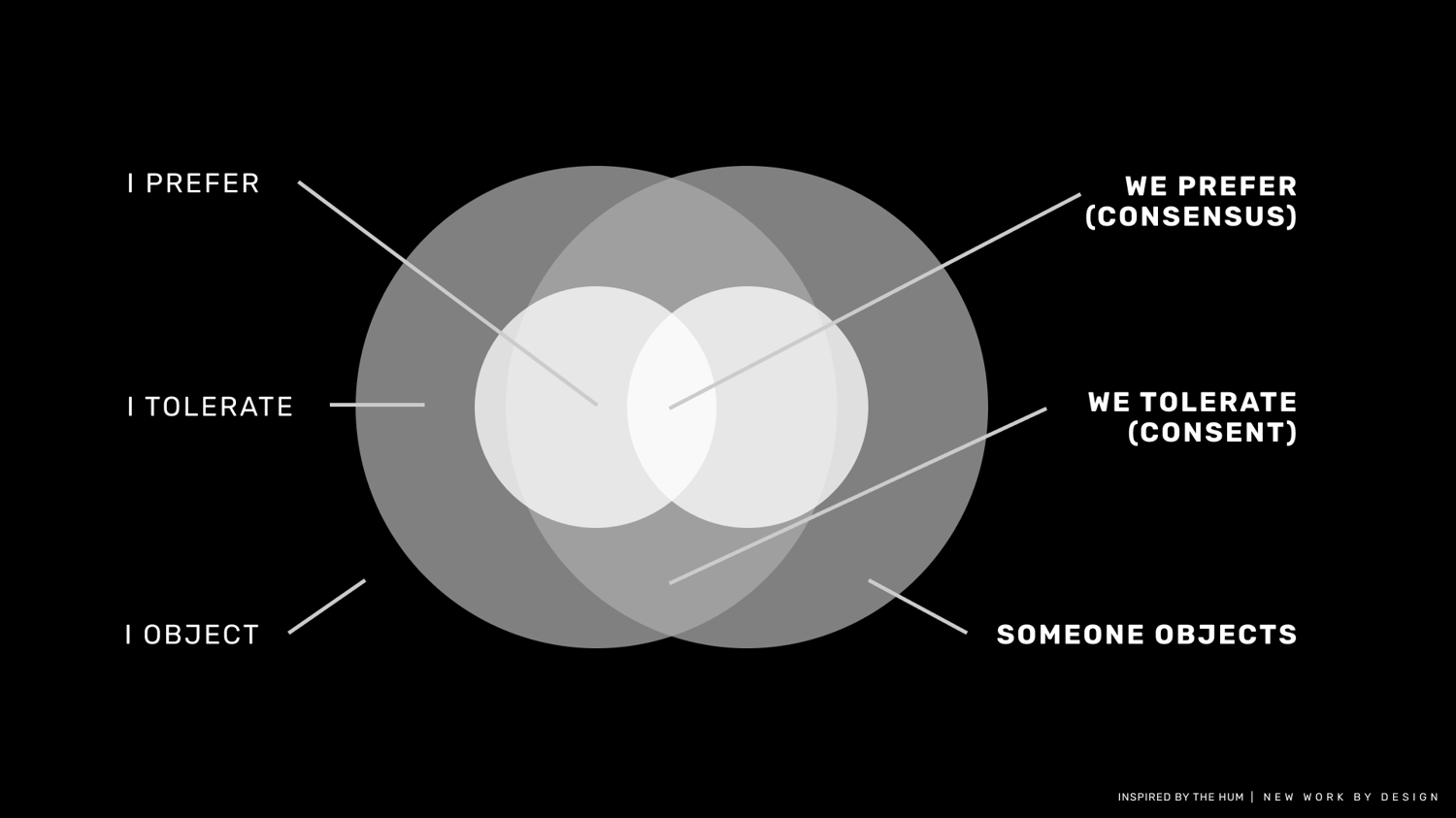
Consent is often confused with consensus, or simply not known at all.
While consensus means everyone is for a proposal, consent means nobody is against it.
At first glance, these might sound like the same thing, but understanding the difference can have a big impact on how effectively decisions are made. They are, in fact, the same, if you only have two voting options: "for" and "against".
However, adding a third voting option, unlocks more flexible decision-making. Welcome to consent.
There is a lot in this visual, so let's build it up step-by-step.
Two voting options

Imagine this circle containing all the solutions you are "for"—in consent terms, this means you "prefer" them. Outside this circle are the solutions you are "against"—or in consent terms, those you 'object' to.
Note: Objections are slightly different from simply being against a solution. More on that in next week's issue.
A third voting option

Once you add a third voting option that sounds like “I can live with this,” you significantly increase the space of viable solutions.
For example, in a planning meeting, instead of everyone needing to fully support a plan to move forward, you could agree on a solution that most people are okay with, even if it's not their top choice.
This third voting option expands your inner "I prefer" circle with a surrounding "I tolerate" circle.
"I tolerate" may sound a bit negative and passive, but really it is a "mutual willingness" that is influenced by listening to others' needs, and being willing to 'give up' my preference if I feel heard and understood.
Finding the overlaps

Now, if you lay someone else's circles on top of yours, it becomes apparent that the space where the outer "I tolerate" circles overlap is much bigger than the space where the inner "I prefer" circles overlap.
For example, think of two colleagues choosing a lunch spot. They may have different favorite places ('I prefer'), but both might be okay with a certain café ('I tolerate'), even if it’s not their top choice. This makes it much easier to find a mutually agreeable solution.
Consent vs. Consensus

The overlap of the inner "I prefer" circles is the set of solutions you can reach consensus. The overlap of the surrounding "I tolerate" circles is the set of solutions you can reach consent.
When to favor consent
There are two reasons to favor consent over consensus:
- Speeding up decisions: You can reach consent faster with less discussion. For example, in a team meeting, rather than debating endlessly until everyone agrees, using consent allows the team to move forward once no one strongly objects, saving valuable time.
- Unblocking progress: Sometimes there are no consensus solutions because the "I prefer" circles don't overlap. Imagine a project deadline approaching and team members having different ideal solutions. Consent helps in choosing a solution that everyone can tolerate, even if it isn't anyone's top choice, ensuring progress rather than getting stuck.
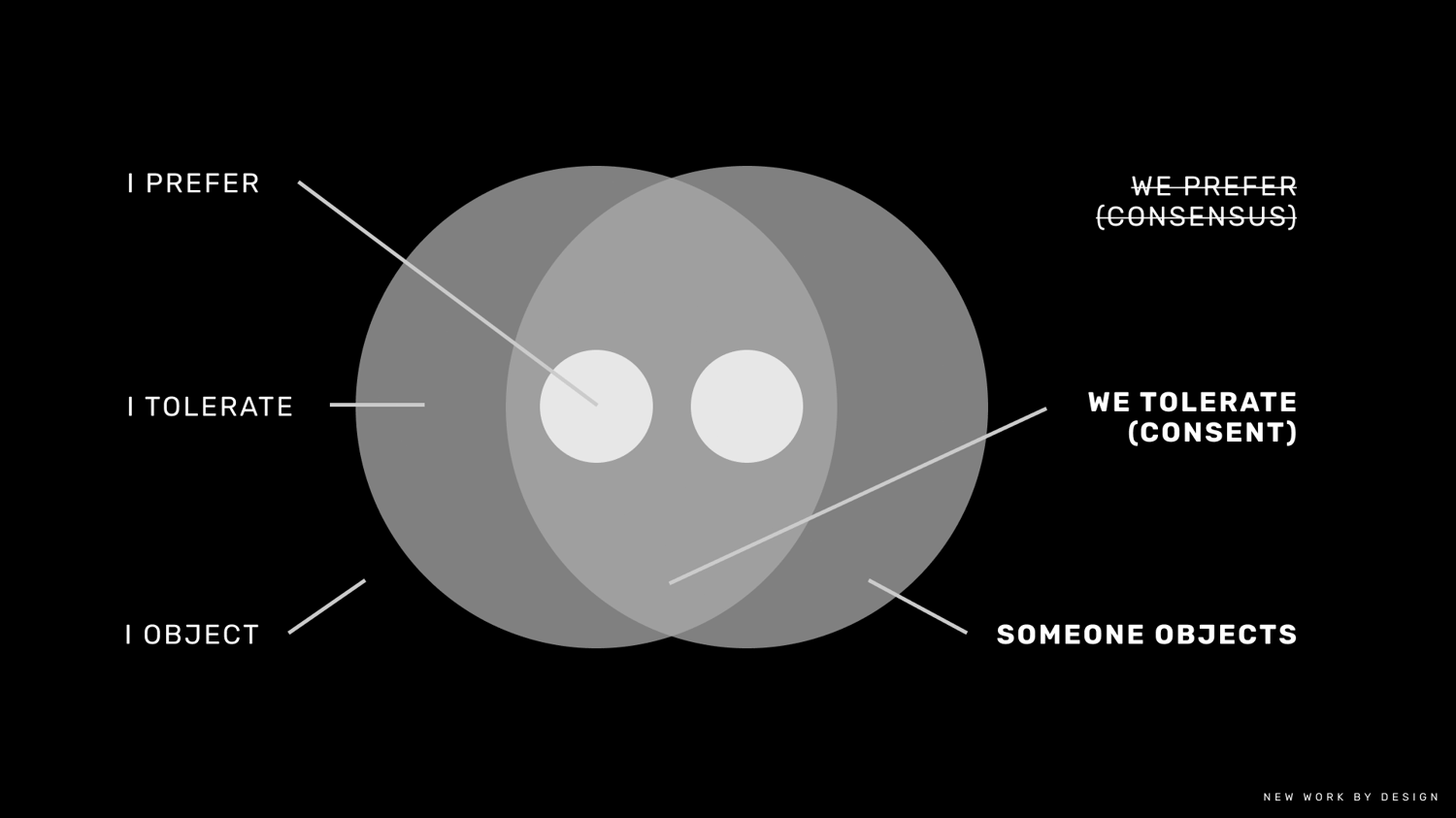
A simple experiment
As you collaborate this week, consider how striving for consensus might be slowing you down. Instead, aim for consent where possible—this can help you make decisions faster and keep the momentum going. When you find a point of tension, try the following:
- Identify Options: Ask yourself and others to name the options you’re open to tolerating, even if they’re not ideal. Go first. Then ask others.
- Find Overlap: See if there are solutions everyone can tolerate.
- Choose and Try: Agree to test one of these “tolerable” solutions, acknowledging it doesn’t have to be perfect—just good enough for now, safe enough to try.
If you try this approach, you might find decision-making becoming easier and your team feeling more flexible.
Learn how to make decisions with consent in my workshop How to make decisions without waiting for a boss. If you want to receive visualized concepts like this with simple experiments in your inbox when they come out on Monday mornings, sign up at visuals.newworkbydesign.com
Comments ()