

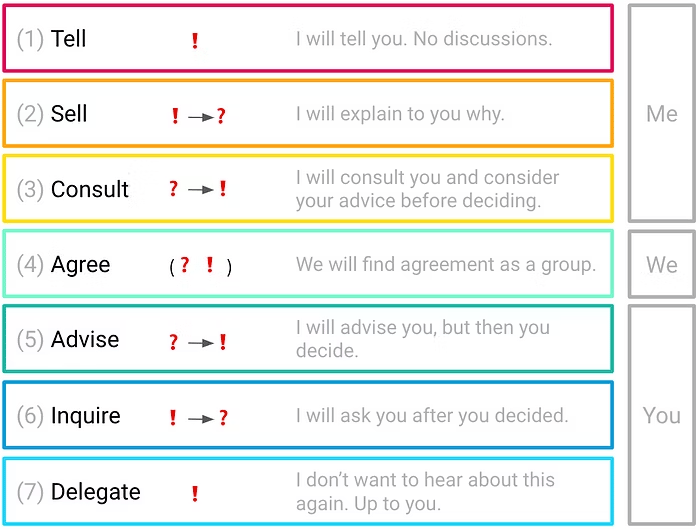
When discussing decision-making, use the 7 levels of delegation to categorize decisions. This framework clarifies who makes the decision (!) and if anybody needs to be asked (?) beforehand. Use appropriate decision-making practices on each level.
In order of preference, use...
(2) Sell when it's safe to fail
When faced with a decision, first consider reversibility and consequence before choosing an appropriate decision-making approach.

from the celebrate Decision-making booklet
- Just (un)do it: For decisions that are easy to undo and have little impact, make them on your own. Many operational one-off decisions fall into this category. In these cases, “asking for forgiveness, instead of permission” is the best option because it is fast and creates momentum.
- Move fast and learn: Decisions that are hard to undo but have little impact are ideal for learning. Mistakes here are cheap, and the lessons learned help avoid more costly mistakes. For example, buying an adapter (€50) independently can reveal who has valuable input for hardware decisions, informing future significant purchases like a laptop (€2000).
- Experiment deliberately: Decisions that have big impact but are easy to undo are perfect for experimenting. If the decision proves poor, it can be quickly reverted after gathering evidence. This allows arguments to be based on facts rather than opinions. For instance, you might work with a candidate as a freelancer before offering them a full-time position.
When decisions are both hard to undo and high impact, make them carefully and methodically by using one of the following practices.
(2) Sell when you have a mandate
The simplest case for making decisions is when you have a mandate — either given by the group you are deciding for or by a role you fulfill. Most operational, case-by-case decisions fall into this category.
Avoid creating role descriptions that are detailed checklists of specific tasks, as they lead to “dumb” behavior along the lines of “Not my fault. I just followed the rules.” Instead, make the mandates of roles explicit by defining high-level decision areas. This enables leadership and accountability.
(4) Agree in small teams
When no individual has the mandate to make a decision, default to a group decision by the affected group using the group consent process. Favor consent over majority vote or consensus. While consensus implies everyone supports a proposal, consent means no one actively opposes it. At first glance, this might seem like a semantic difference, but it highlights an important nuance: alongside “I prefer” and “I object,” people have a third position: “I tolerate.”
(3) Consult in big groups or if you can't agree
For decisions in big groups (where group consent is too inefficient) or after unsuccessfully using the consent process, give the decision to an individual who actively consults experts and those affected. This is often called an advice process. The greater the decision's impact, the more people should be consulted. While the decision-maker must consider all advice received, the responsibility and ownership of the decision remain clearly with them.
(1) Tell as a last resort
Management, as invented 100 years ago by Taylor, has served us well in the industrial age. The division between thinking by a few on the top that tell the many on the bottom what to do, afforded massive efficiency gains. However, when applied to knowledge work instead of physical work, these advantages mostly disappear and are counteracted by disengaged knowledge workers that get paid to think. Reserve authoritative decisions for emergencies and a last resort escalation when all else fails.
Conclusion
Progress requires making decisions. By decentralizing decision-making, you enable progress throughout the organization while at the same time getting more engaged colleagues.
While decentralized decision-making demands more effort than top-down decisions, this trade-off is worth it. It grants higher autonomy to teams and individuals, leading to more innovative products and more fulfilled people. Being clear on which decision-making practice to use in each context helps mitigate the drawbacks of this approach.

I didn't touch on (5), (6), and (7). They are basically the mirrored side of (3), (2), and (1) respectively.
You can find step-by-step instructions for group consent and the advice process, as well as proposal templates and examples in the Decision-making section of the Transformation course.
Comments ()