

An adult-to-adult relationship is a dynamic where two individuals engage as equals, grounded in mutual respect, open communication, and shared responsibility. It emphasizes emotional maturity and avoids power imbalances or manipulative behaviors. Here's what it typically involves:
- Mutual Respect: Each person acknowledges the other's autonomy, values, and boundaries without trying to control or dominate.
- Open Communication: Honest and transparent conversations where both feel safe expressing their thoughts, needs, and feelings without fear of judgment or retaliation.
- Responsibility: Both take responsibility for their actions, emotions, and contributions to the relationship, avoiding blame or victimization.
- Emotional Regulation: Instead of reacting impulsively, both individuals strive to respond thoughtfully, managing their emotions in a constructive way.
- Integrative Power: Decisions are made collaboratively, valuing each person’s input, rather than one person imposing their will on the other.
- Personal Growth: Both encourage each other’s growth and independence while maintaining the connection.
- Conflict Resolution: Problems are approached with curiosity and a willingness to find solutions together, rather than escalating into arguments or passive-aggressive behaviors.
An adult-to-adult relationship recognizes that neither person is "in charge" of the other’s happiness, and both commit to contributing positively while maintaining their individuality.
Origin
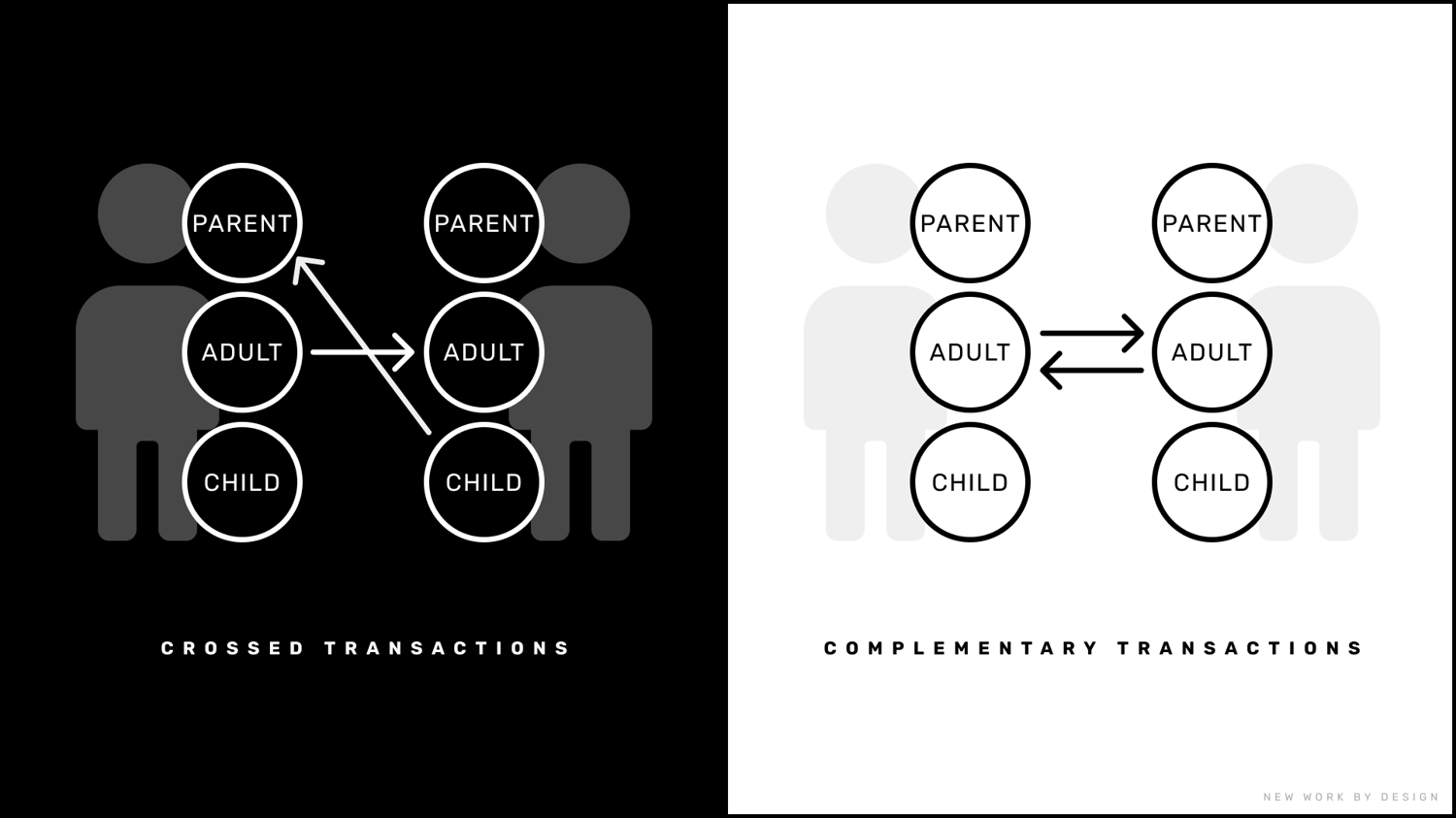
In Transactional Analysis (TA), developed by Eric Berne in the 1950s, the concept of adult-to-adult interactions is central to the theory’s understanding of healthy, productive communication. He distinguishes between three ego states:
- Parent: Learned behavior (i.e. norms) from own parents or society
- Adult: Logical and thoughtful behavior
- Child: Spontaneous, intuitive, and creative behavior, play, and joy

He then uses these ego states to analyze interactions between individuals.
- Complementary transactions: communication proceeds smoothly
- Critical gossip (Parent-Parent)
- 🗣️ "The management team has no idea what they're doing."
- 🗣️ "I know, they’re always making decisions without consulting us."
- Solving a problem (Adult-Adult)
- 🗣️ "Do you know why the API request is failing?"
- 🗣️ Yes, the response format changed." or "No, I haven’t checked yet—let’s debug it together."
- Playing together (Child-Child or Parent-Child)
- 🗣️ "Want to play a quick game of table tennis during the break?"
- 🗣️ "Sure, but don’t complain when I beat you again!"
- Crossed: communication is broken off
- Defensive (Adult -> Adult, Rebellious Child -> Parent)
- 🗣️ "Do you know why the API request is failing?"
- 🗣️ "Why do you think I broke it?"
- Collapsing (Adult -> Adult, Submissive Child -> Parent)
- 🗣️ "Do you know why the API request is failing?"
- 🗣️ "I am sorry! I mess it up again."
- Lecturing (Adult -> Adult, Critical Parent -> Child)
- 🗣️ "Do you know why the API request is failing?"
- 🗣️ "Why don’t you read the documentation? It’s not my job to babysit you."
- Care-taking (Adult -> Adult, Nurturing Parent -> Child)
- 🗣️ "Do you know why the API request is failing?"
- 🗣️ "I didn't know it was. I'll take care of it."
Street metaphor

You can think of adult-to-adult relationships like a shared street where both individuals follow these three guiding principles:
- Owning my side of the street: I take full responsibility for my side by regulating my emotions, owning my actions, and addressing my challenges without blaming others. I stay committed to personal growth and ensure that my behavior aligns with respect and accountability.
- Trusting you to own your side: I trust in your ability (or at least potential) to manage your side, make your own decisions, and handle challenges. I communicate openly and transparently, without withholding information or overstepping due to fear or a need for control. I honor your autonomy and don’t try to "fix" your side for you.
- Being a good neighbor: I respect the boundary between our sides of the street. I don’t throw my trash (emotional baggage, blame, or manipulation) onto your side. At the same time, I offer support and collaboration when you genuinely need help, ensuring I don’t take over or undermine your ownership of your responsibilities.
Interview with Lisa Gill
P.S. If you want to have more adult-to-adult relationships at work, consider my "Understanding how we Relate" workshop or my leadership program.
Comments ()